
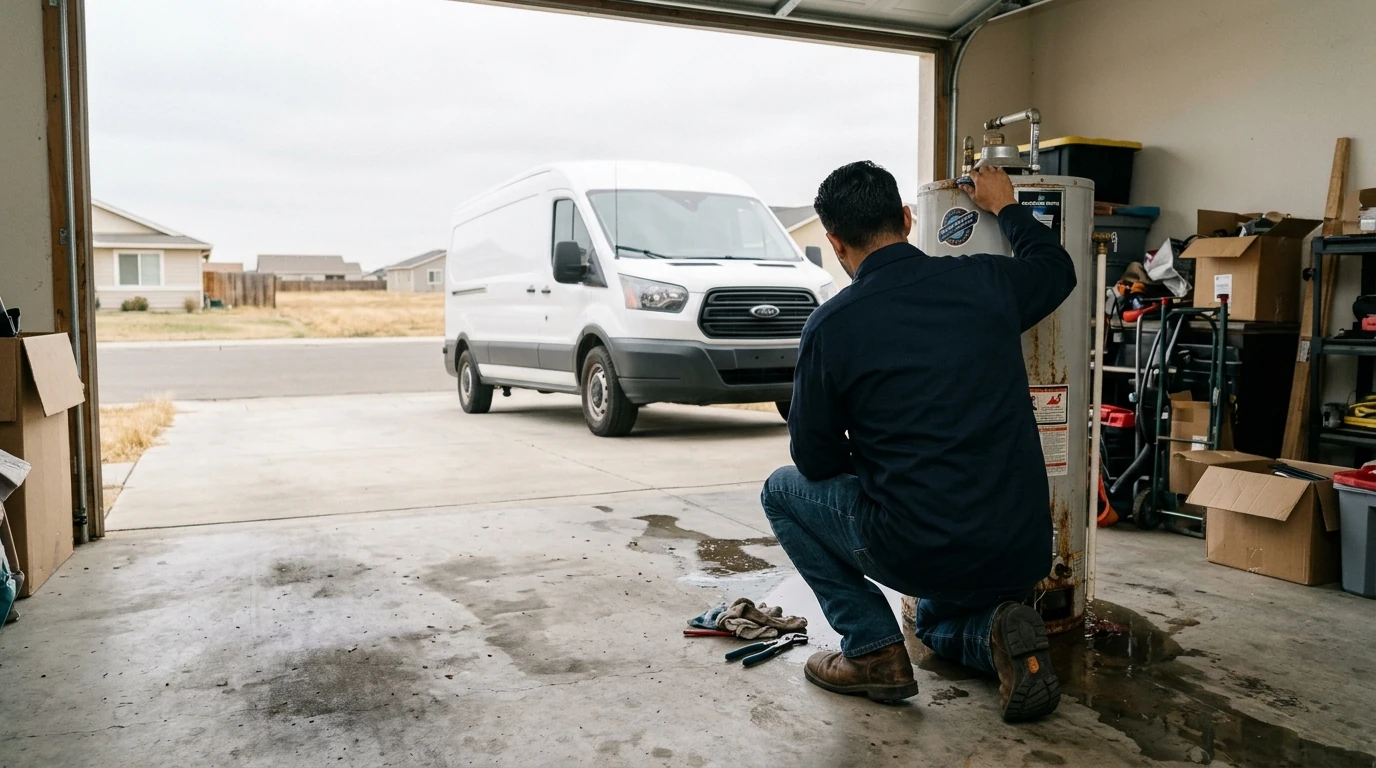
For a water heater burst in Bakersfield, call ProRestoration Services at (661) 393-9306 the moment you’ve shut off the water and power, 24/7, and the crew that answers can also dispatch the sister plumbing company to deal with the tank itself. A failed 40-50 gallon tank empties fast, and if the cold supply line isn’t shut at the valve, it keeps refilling and keeps leaking. The first five minutes matter more than almost any other water loss you’ll deal with as a homeowner.
Is This a Plumber Call or a Restoration Call?
It’s usually both, and that’s the whole reason a one-call setup exists. If water is still actively flowing, the plumbing side needs to shut the source and assess whether the tank is repairable or needs replacement. Once the source is stopped, the water-damage side needs to start extraction before 40-50 gallons soaks into flooring, baseboards, and drywall.
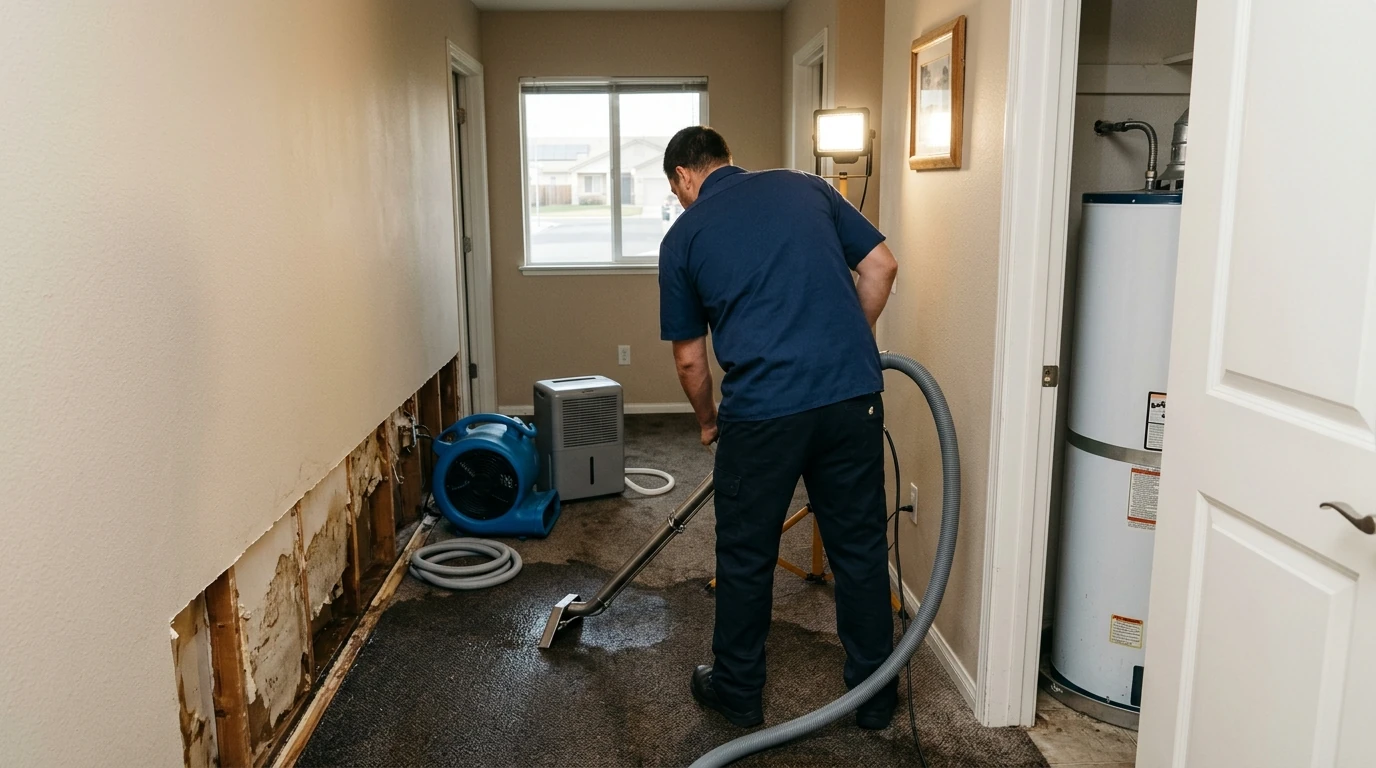
In Bakersfield, where a lot of water heaters sit in an attached garage, the damage often stays contained to the garage slab and maybe the wall shared with the house. In Oleander, Westchester, and other pre-1970 neighborhoods where the heater sits in an interior closet or hallway, that same 40-50 gallons has nowhere to go but under adjoining flooring and up through the baseboards into drywall, which wicks water much further than people expect. A garage failure is a cleanup job. An interior-closet failure in an older Bakersfield home is often a drying job that takes several days and may involve removing baseboard and some drywall.
What Do I Do in the First Five Minutes?
Shut the cold water supply valve at the top of the tank first, then cut power to the unit before you touch anything else. These two steps stop the problem from getting worse while you wait for help.
- Find the cold inlet valve on top of the tank (it’s usually the one with a blue handle or marked “cold”) and turn it clockwise until it stops. This cuts the water actively refilling the tank as it drains.
- Cut the power. For a gas unit, turn the gas control knob to “pilot” or “off”, or shut the gas valve on the line feeding the heater. For an electric unit, flip the dedicated breaker at your panel.
- If you smell gas, stop. Don’t touch the valve, don’t flip anything, leave the garage or home and call the gas company or 911 from outside. Gas smell changes this from a water problem to a safety problem.
- Move anything you can off the floor in the affected room: stored boxes, rugs, furniture legs. Don’t try to mop up 40-plus gallons yourself; that’s what extraction equipment is for.
- Take photos of the tank, the standing water, and any affected walls or flooring before anything is moved or dried. This protects your insurance claim later.
Fresh tank water starts out as Category 1, clean water from a sanitary source under the IICRC S500 standard, but it doesn’t stay that way once it sits on a garage floor, picks up sediment, or soaks into drywall and carpet pad for more than a day or two. That’s one more reason to get it pulled up fast rather than letting it dry on its own.
Will Insurance Cover a Burst Water Heater?
Most homeowners policies cover sudden, accidental tank failure, but they typically exclude damage caused by gradual wear, like a slow corrosion leak that was dripping for weeks before anyone noticed. Bakersfield’s hard water accelerates sediment buildup inside the tank, which speeds up corrosion over the years. Whether the policy pays usually comes down to whether the failure was sudden (a seam splitting, a fitting giving way) or the end stage of a leak that had been going on for a while. Your adjuster will often ask about the tank’s age and whether there’s any sign of prior leaking, so the photos from step four matter. For more on what a standard policy actually covers, see the Insurance Information Institute’s guide on homeowners coverage, and our own breakdown in does homeowners insurance cover water damage.
What Happens After You Call?
On the call, expect to be asked whether the water is still flowing, where the heater is located (garage vs. interior), and roughly how long it’s been leaking. That tells the dispatcher whether to send a plumber first, a water technician first, or both at once.
On arrival, a technician checks for standing water and moisture intrusion with a moisture meter, starts extraction if there’s still water on the floor, and sets containment if the affected area borders drying carpet, baseboard, or drywall. If the tank itself needs replacing, that work gets handled by All Pro Plumbing, ProRestoration’s sister plumbing company, so you’re not finding and vetting a second contractor mid-emergency; it’s the same team, one invoice, one point of contact, which is the idea behind “One Call Does It All.” Air movers and a dehumidifier typically go in the same visit if the area needs structural drying, and the crew documents everything with photos for your insurance file.
If the water sat for more than 24 to 48 hours before anyone caught it, mention that on the call. Damp drywall and baseboard left that long are where mold can start to take hold, and it changes how the drying plan gets scoped.
If you’re not sure whether what you’re dealing with is a burst heater or a supply line failure elsewhere in the house, our guide on a burst pipe in Bakersfield walks through that distinction, since the first-call decision is similar but the water volume and source are different.
About ProRestoration Services
ProRestoration Services is an IICRC-certified, EPA Lead-Safe Certified firm serving Bakersfield and Kern County, licensed through the Contractors State License Board (license #960566) and BBB Accredited. The crew handles water damage restoration, emergency water removal, appliance leak cleanup, emergency plumbing (through sister company All Pro Plumbing), and mold remediation across the Bakersfield area, with a 24/7 line for active water emergencies.